
Project Millennium
.png)
The Backdrop
America, our allies, and the sovereign world face a terrifying reality: low-cost, unmanned weapons systems now dominate modern warfare, and our adversaries, primarily the People’s Republic of China and Russia, are the undisputed experts in their production. These attritable systems, such as FPVs and other types of drones, share far more DNA with consumer electronics than legacy defense platforms. Consequently, having outsourced our consumer electronics and broader industrial capacity to Asia, the remaining American industrial base is fundamentally unable to support the drone production velocity that modern conflict and credible deterrence demand.
However, there is a positive outlook. If sovereign nations move decisively to rebuild their own drone capabilities, they will unlock an asymmetric advantage that traditional weapons systems simply cannot match. While specific tactics may evolve between theaters, the strategic lessons from Ukraine are undeniable: invasions require boots on the ground—a threat that low-cost, mass-producible drones are uniquely suited to counter.
It is existential that America and her allies build this credible deterrence at scale. Through Project Millennium, Neros is aligning the direction of our company with the urgent needs of the free world. Our mission is clear. We must create a drone industrial base that is competitive with China.
Part 1: Millennium One
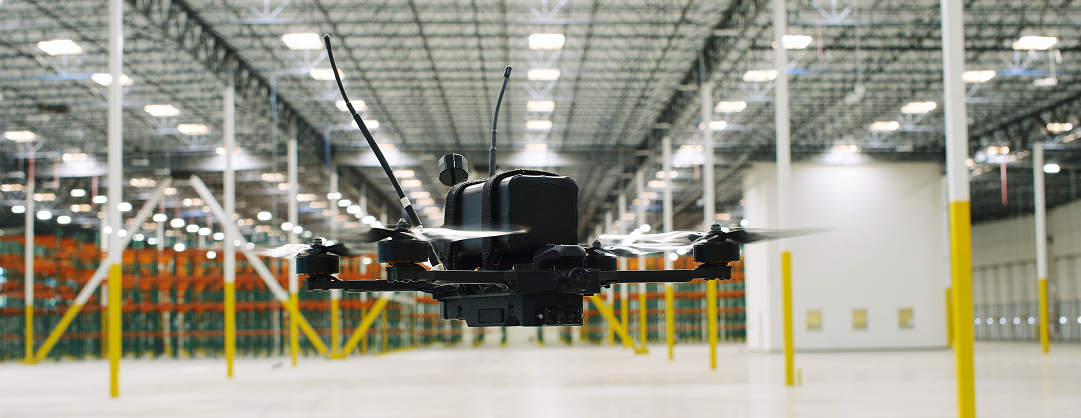
In 2025, Neros became the highest-output American drone manufacturer, operating efficiently within a 15,000-square-foot footprint. We validated crucial parts of our assembly and test operations and proved we can deliver thousands of units at internationally competitive cost on American soil. However, to successfully meet the call of strategic deterrence, we are scaling our productive capacity by 100x. The coming years will be defined by developing our ultimate product: the factory itself.
Millennium One (M-1) represents a watershed moment in drone industrialization. Our 250,000-square-foot facility in Los Angeles will serve as Neros’s new global headquarters and the engine for producing American drones and components not in the tens of thousands, but in the millions. Neros occupies M-1 in early 2026, launching a multi-year build-out that will facilitate rapid team expansion and the massive scaling of assembly and test operations. Crucially, this facility is designed to secure domestic manufacturing capacity for our most vital sub-systems. We are prioritizing the immediate onshoring of high-risk components, ensuring that the core technologies driving our systems are immune to foreign supply threats.
By building our next headquarters in Los Angeles, we are doubling down on our access to the elite aerospace and technology talent pools of coastal California. M-1 will eliminate critical bottlenecks and adversarial risks in the Western drone supply chain by scrutinizing every dependency on China and scaling resilient, domestic alternatives. We will create the nexus which seeds a diverse, distributed manufacturing network.
M-1 is more than a building; it is a blueprint. It will prove that sovereign, industrial-scale drone production is possible and serve as the model for a future network of factories across the country and the globe. Future Millennium factories will be built on the lessons learned here, optimizing for robust manufacturing support for decades to come. These buildings will house all of the core manufacturing processes required to output FPV systems, as well as other types of drones. Neros’ investment into M-1 is a bold commitment that reflects a stark truth: the current pace of the defense industrial base is insufficient. We are moving faster because the mission demands it.
.png)
As we bring M-1 online, we are building a national asset with massive component production volume designed to serve the entire US industrial base. Our mission is predicated on collaborating with, and unifying, the allied drone ecosystem to successfully compete against the PRC - a combined effort is the only way to win. Neros will act as the anchor customer for this output to guarantee stable operations, but we are designing M-1 to support other domestic OEMs with secure component supplies and licensed technologies. We will leverage our scale to de-risk the component value chain for ourselves and other manufacturers while creating opportunities for allied players to develop net-new platforms and capabilities.
Part Two: Global Resilience
Drone Dominance for the West is necessarily an allied effort. The vast majority of feedback driving our product design comes directly from our operations in Ukraine, and in 2026 we are expanding our presence in Kyiv, in addition to other European nations and across the Indo-Pacific. A core pillar of Project Millennium is a global manufacturing strategy that provides our partners with certain capability in uncertain conditions.
Starting in 2026, Neros will begin the production of its flagship Neros Archer-FPV systems in the APAC region, alongside novel designs tailored to international military needs. This is not a concept, but a reality already in motion. In conjunction with local partners, Neros has qualified the suppliers necessary to build Neros Archer-FPVs entirely from First Island Chain components, leveraging the strong electronics manufacturing bases of various APAC nations while injecting our own battle-proven drone technology that they currently lack.
While Millennium One serves as a high-volume backstop for America, our region-specific manufacturing provides hubs of distributed resilience closest to the point of need. This is the productive capacity that creates real, credible deterrence.
Part Three: Technical Superiority
Two forces have driven affordable drone technology in the last decade: high-volume consumer demand and demand arising from the invasion of Ukraine. In both arenas, China has dominated. Across consumer drone technologies, their advantage in scale, cost, and capability is abundantly clear. Less clear, but perhaps more impactful, is Chinese preeminence of battlefield supply chains. Although Ukraine (and, objectively, Russia as well) has innovated quickly to develop new drone technologies and tactics, almost all of the industrial, economic, and informational benefit has flowed back to the PRC. Despite the West's best efforts to catch up, DJI remains the undisputed king of short range reconnaissance and digital links over the entire front. China’s monstrous electronics industrial base produces over 90% of the component value of all Group 1 drones being used by both sides of the war.
Project Millennium will reverse this trend by putting production first. In modern warfare, just as in conflicts of the last century, one axiom has seemingly remained true: industrial capacity is the ultimate deterrent and the ultimate capability. Low-cost drones only change the calculus of war if we can build enough of them to make a conflict mathematically untenable for our enemies. The technology we have today can deter conflict, contingent on being delivered in sustainable, massive quantities. America is and always has been exceptional; we know what it means to come from behind and outproduce an adversary. The challenge now is to do it again, in a new domain, and in a new time. To secure Western strategic dominance, we must close the gap and then exceed our adversaries.
The final pillar of Project Millennium is large, directed investment into four key technology areas: communications, sensors, autonomy, and manufacturing systems. We believe these technologies will define the future of unmanned systems. Our engineering philosophy is therefore defined by two non-negotiable standards: rapid iteration and battle-ready utility. We do not build delicate one-offs; we build ruggedized, field-hardened platforms designed to evolve faster than the adversary. By tightening the feedback loop between the factory floor and the front line, we ensure that every unit we ship is not just technologically advanced, but practically useful in the hands of the operator.
We also recognize that the right strategic partnerships act as powerful accelerants to this mission. We actively seek out best-in-class innovators to integrate specific capabilities without reinventing the wheel. Through our collaboration with Kraken Kinetics, Neros Archer-Strike became the first kinetic-enabled FPV drone fielded broadly by the Department of War. Working with Kela Technologies, Neros Archer-Fiber became the first NDAA-compliant fiber optic FPV drone. And by leveraging active collaborations with innovative companies in Ukraine, we have greatly expedited the path by which battlefield-tested functionality makes it into the Warfighter’s hands. Neros, alongside our partners, is making the upfront financial investments to secure these technological capabilities—and with them, the future.
Project Millennium is a call to arms for the people and partners who will help us succeed, because we cannot afford to fail.